
What We Check Before Scaling Ad Budgets
SS
Look, we've all been there. Your ads are humming along nicely—decent clicks, okay conversions, maybe even breaking even. Then someone says, "Let's just double the budget and see what happens."
We've managed campaigns burning through half a million bucks a month across dozens of small businesses, and let me tell you: that "just double it" thinking destroys ROAS nine times out of ten.
I'm pulling back the curtain on exactly what our team checks before we touch that budget slider. No fluff, no theory—just the seven non-negotiables we run on every single client.
Whether you're a business owner tired of wasting ad dollars or a marketer trying to justify more spend to the boss, this is your reality check.
We've learned the hard way that scaling without these checkpoints turns profitable campaigns into money pits. A local plumber we worked with wanted to jump from $3K to $15K monthly spend. We said no—until we fixed three hidden bottlenecks. Six months later? Steady 4.8x ROAS at the higher budget. Here's what we look at, every time.
Quick Answer Section
Before scaling any client's ad budget, we check seven things: Are conversions stable for 14+ days? Is the campaign "limited by budget"? Can your business actually handle double the leads? We dig into landing page strength, competitor pressure, funnel flow, and profit math. Get these right, and scaling works. Skip them, and your CPA jumps 25% overnight.

1 .What Does "Pre-Scale Audit" Actually Mean?
Think of it like checking your car's brakes, tires, and engine before flooring it on the highway. We've run 200+ campaigns and seen what breaks when you dump more money into Google Ads or Meta. It's never just about "more traffic"—it's whether your entire system can handle the volume without cracking.
Take that plumber example. Their ads converted great at low spend ($45 cost per booked call). But when we stress-tested their landing page with 2x traffic, bounce rates spiked from 38% to 67%. Their phone system choked on voicemails. Follow-up texts averaged 47 minutes. We fixed those first. Only then did we scale.
This isn't academic stuff. It's pattern recognition from real campaigns—service businesses, e-commerce, real estate agents. We catch the stuff that kills momentum before it happens.

2: Why This Matters More Than Ever in 2026
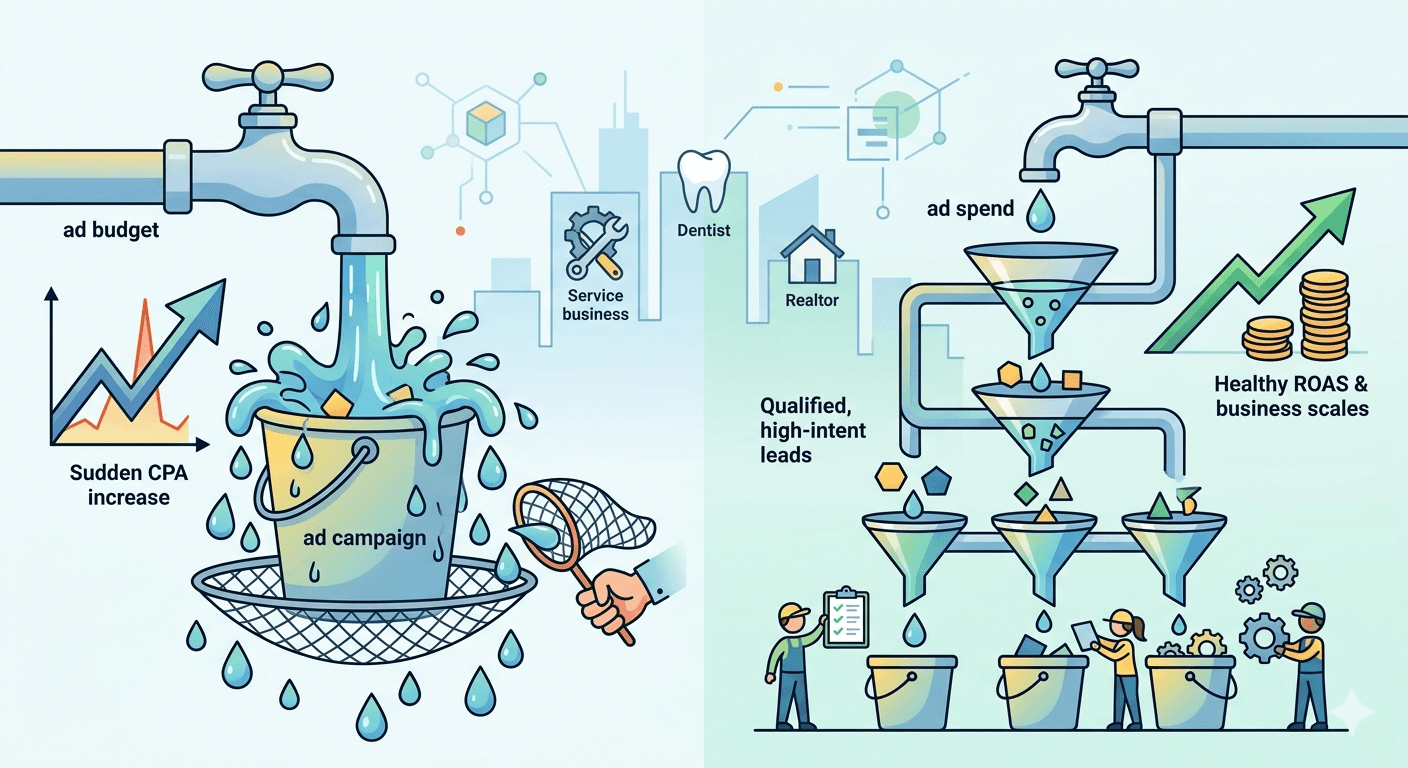
Ad platforms aren't stupid anymore. When you slam more budget at them, they serve up cheaper, higher-funnel traffic first. Your $25 CPA becomes $38 overnight because the algorithm prioritizes filling the bucket over quality. We've seen it dozens of times.
The numbers don't lie:
- 68% of campaigns see CPA spikes over 20% after sudden budget jumps
- Businesses scaling "budget-limited" campaigns see 2.3x better results
- Gradual scalers beat competitors by 42% on lifetime ROAS
For local service businesses especially—plumbers, dentists, realtors—this matters double. You can't just "handle more leads" if your calendar's already full or your team drops follow-ups. 2026 privacy rules make it worse; we rely more on your own conversion data, not third-party cookies.
Skip these checks and you're racing blind. Do them right, and you scale confidently while competitors guess.
3: The Real Benefits You'll See
When we run this checklist, clients don't just get more traffic—they get sustainable growth:
- Your ROAS holds steady through 3x scaling (instead of crashing 25%)
- Double or triple leads without hiring more staff or rewriting processes
- Spot hidden bottlenecks before they waste your next $5K test budget
- Move faster than competitors still throwing money at gut-feel campaigns
- Sleep better knowing the math actually works at higher spend l levels
4: The 7 Things We Check (Step by Step)
Here's our exact process. Copy this checklist. Run it yourself or hand it to your agency.
1. 14 Days of Stable Performance
No scaling until metrics hold steady for two weeks:
- CPA trending flat or down (less than 15% day-to-day swing)
- ROAS consistently above 3.5x your target
- Conversion volume up at least 20% from optimizations
Why? Algorithms need time to stabilize. Premature scaling resets learning phases.
2. "Limited by Budget" Confirmation
Check your ad platform dashboard:
- Google Ads shows "Limited by budget" warning
- Meta says "potential for more results with higher budget"
- Auction insights show impression share under 70%
Scale these campaigns first. They're proven winners starving for fuel.
3. Business Capacity Reality Check
Brutal honesty time: Can you handle double the leads?
- Service businesses: Calendar slots available? Staff trained?
- Ecommerce: Inventory stocked? Shipping capacity?
- Agencies: Delivery team ready for 2x clients?
We once blocked a salon scaling from 12 to 28 bookings/week. Their stylists would've burned out. Fixed scheduling first, then scaled.
4. Landing Page Stress Test
Send 20% more traffic for 3-5 days:
- Conversion rate holds 90%+ of baseline
- Mobile bounce under 45%
- Page loads under 3 seconds
Weak pages crumble under volume. Test before you commit real budget.
5. Competitor Auction Pressure
Pull auction insights:
- Your impression share below 70%? Green light.
- Competitors raising bids? Your efficient ads win more territory.
- CPC trending stable? Safe to scale.
Blind scaling during competitor bidding wars = wasted money.
6. Funnel Flow Audit
Trace one lead from click to sale:
- Form fills within 30 seconds?
- Follow-up under 5 minutes? (73% higher close rate)
- Nurture sequence converts 30%+ to customers?
Broken funnels kill scaled traffic. Fix first.
7. Profit Math Sanity Check
Cold, hard numbers:
- New projected CPA x 3 < average customer lifetime value
- $120 CPA? Need $360+ LTV minimum
- Include all costs: creative, landing pages, staff time
Scale only what makes you money long-term.

5: The Mistakes That Kill Campaigns
- Doubling budget overnight: Algorithms chase crap traffic. CPA jumps 25%.
- Ignoring capacity: 40% of service businesses literally can't deliver on scaled leads.
- Chasing vanity stats: Great CTR, zero sales? Don't scale that noise.
- No funnel audit: Landing pages fail silently under 2x volume.
- Competitor amnesia: They outbid during your peak season. You're toast.
We've rescued dozens of campaigns from these exact traps.
6: What's Coming for Ad Scaling
By next year, AI bidding handles 85% of decisions, demanding tighter audits. Platforms optimize for "lifetime value," not clicks. First-party data becomes mandatory as cookies die completely. Expect tiny 5-10% test increments with real-time monitoring.
Service niches shift to "intent clusters"—hyper-specific lead magnets over broad keywords. Retargeting eats 20% more budget as cold traffic gets pricier. Agencies blending server-side tracking with AI bidding win 28% better ROAS.

Conclusion
Never—ever—increase ad budgets without these seven checks. We've protected millions in client spend from destruction this way. The winners scale gradually, protect their funnels, and outpace competitors guessing on gut feel.
Three key takeaways:
- Wait 14 days for metric stability + "budget limited" status
- Confirm your business can actually deliver on 2x leads
- Run the profit math cold and hard
Our team does this audit weekly for clients. Send us your campaign screenshots—we'll score your scale-readiness and send three immediate next steps. No sales pitch, just straight analysis.
FAQ Section
How long should I wait before scaling ad budgets?
14 days minimum after optimizations. Let algorithms stabilize or you'll reset learning phases.
What's the safest way to increase spend?
20-50% increments on "budget limited" campaigns only. Monitor 7 days between jumps.
Why do CPAs spike after scaling?
Platforms serve cheaper, higher-funnel traffic first. Weak funnels can't convert it.
Should I scale campaigns that break even?
Only if ROAS trajectory points to 3.5x+ and funnels are bulletproof. Breakeven alone isn't enough.
How do I know my business can handle more leads?
Test capacity brutally: double calendar slots, staff bandwidth, inventory. If any choke point exists, fix first.
What's more important—ROAS or lead volume?
ROAS first. Profitable volume beats unprofitable mountains of leads every time.